An advertisement can only get someone to the page. Everything after that is the page's job — and that is where most of the money is actually lost.
You can see it in the numbers when it happens: clicks arrive, the cost per click looks reasonable, and almost nobody writes. The campaign gets blamed. Usually the page never told the visitor what they needed to know.
The page has one job
Not to describe the whole business. To take one specific person, with one specific problem, to one next step.
If the page tries to serve everybody, the visitor has to work out for themselves whether it is meant for them. Most of them will not do that work. They came from a feed or an assistant's answer, and the alternative to reading is one tap back.
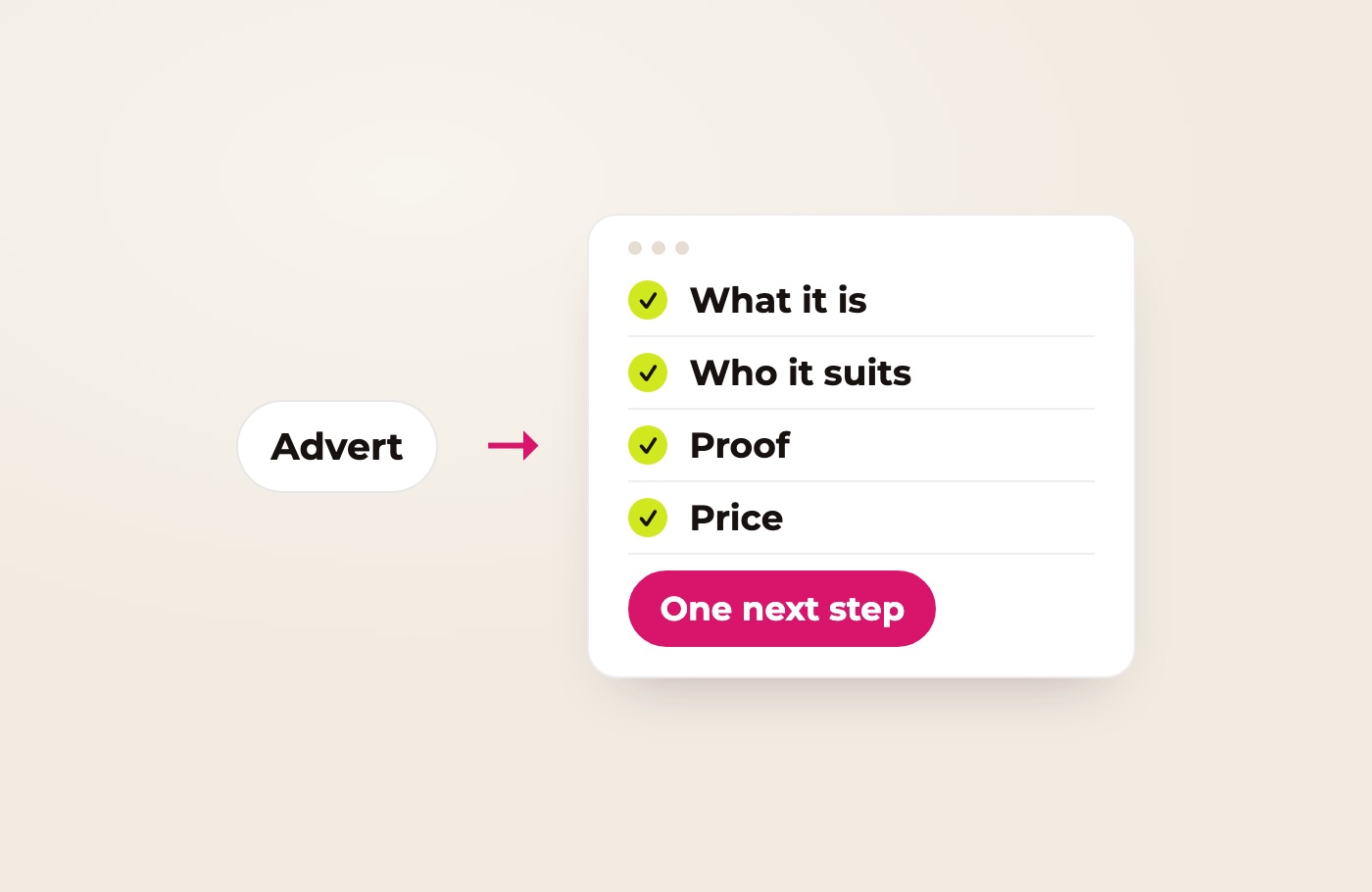
- What this isthe service named the way clients name it
- Who it suitsand who it does not
- What backs it upnumbers, reviews, licences, work
- How much and wherea price or a range, the city, the format
- What to do nowone next step, and it is measured
What a visitor has to work out in ten seconds
What this actually is
Named in the words your clients use, not in the words of your profession. People search for a thing that hurts, not for the technique that fixes it.
Who it is for, and who it is not
"For people who sit at a desk all day and wake up with a stiff neck" does more work than "for everyone who cares about their health". Saying who it is not for is not a loss of clients — it is what makes the fit believable to the rest.
How much, and where
A price or a range, and the city or the format. A page that hides both makes the visitor guess, and the usual guess is "expensive, and probably not here".
What happens next
One clear step. Write, book, call. Not three equal options next to each other — that is a choice, and a choice is a delay.
Proof that can be checked
Claims cost nothing to write, so they carry almost nothing. What carries is anything a stranger could verify: how long you have been doing this, how many people you have worked with, licences and qualifications, real reviews with names, photographs of your actual room or actual work.
Two specific facts beat a page of adjectives. "Eleven years, working from a studio in Bolzano, in Italian, German and English" says more than "the leading specialist in the region".
If you have a result you can stand behind, that is what a case study is for — mine is here.
One next step, said more than once
Decide which single action counts as success, and build the page to it: a WhatsApp message, a booking form, a call.
Repeat it. Once in the first screen, once in the middle, once at the end. Someone who is convinced by the third section should not have to scroll back up to find out how to act.
And whatever the step is, it has to work on a phone, in one tap, without a form asking for information you don't need yet. Every extra field is another chance to change their mind.
Tracking, before the traffic
This is the part that gets postponed and shouldn't. Without it you will see clicks, and clicks are not the thing you are buying.
- The pixel for the channel you're running: Meta Pixel, or the OpenAI Pixel for ChatGPT Ads.
- Server-side conversions where they are available — the Conversions API on Meta, its equivalent on OpenAI — so the browser is not the only thing reporting.
- An event on the thing that matters: the enquiry sent, the booking confirmed. Not the page view.
- One test you do yourself before spending anything: send an enquiry through the page and check it arrives, in your inbox and in the reporting.
Advertising in either channel is measured the same way in principle, and I have written about how the two differ in Meta Ads vs ChatGPT Ads: different channels for different moments.
A ten-minute check you can do yourself
Open your page on your phone, as a stranger would.
- Cover the logo. Can you still tell what is sold, to whom and where?
- Time yourself. How long until you find the price or a range?
- Count the next steps offered in the first screen. If it is more than one, cut it to one.
- Find one claim that a stranger could not check, and either back it with a fact or delete it.
- Send yourself an enquiry through the page. Time how long the reply takes.
That last one is often the most uncomfortable, and it is usually the cheapest thing to fix: an answer that arrives while the person is still interested is worth more than another creative. If nobody can answer during the working day, that is a case for automating the booking first.
What this changes about the budget
A page that converts twice as well does not halve your cost per enquiry by accident — it does it arithmetically, and it does it for every euro afterwards.
That is why I look at the page before the campaign. Improving it is almost always cheaper than buying twice the traffic to make up for it. How much traffic you actually need is its own question.