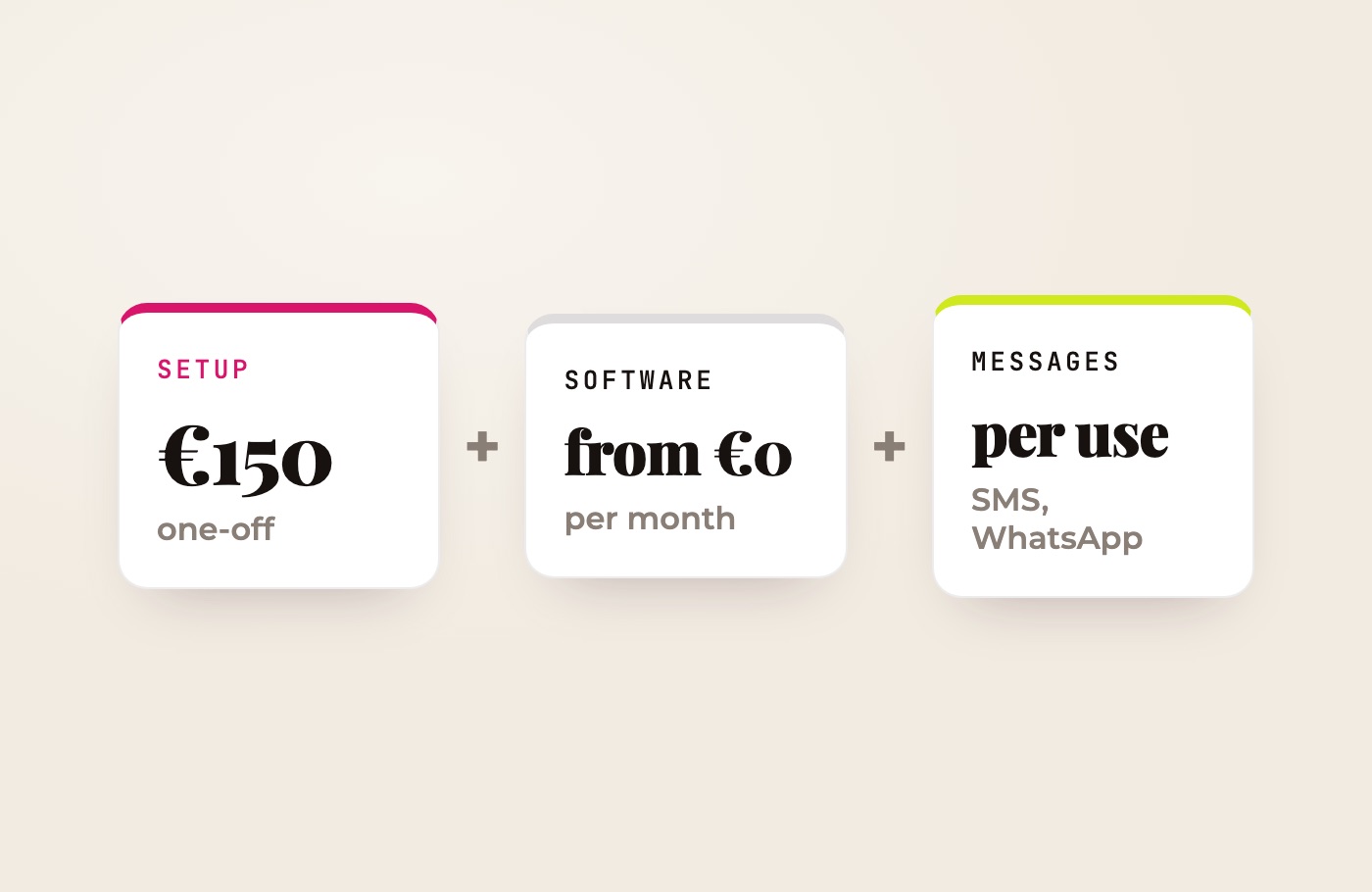
Appointment automation can cost €150 to configure, or it can become a project worth several thousand euros. The difference is not the presence of “AI”; it is the work the system must perform.
A solo professional who needs available slots, calendar sync and one email reminder does not need custom software. A system that must interpret WhatsApp messages, route enquiries between staff, collect payments and update a CRM has a very different scope.
To compare quotes properly, separate three categories: implementation, recurring subscriptions and usage-based charges.
The three parts of the cost
One-off implementation
This is the specialist’s work: reviewing the process, selecting a suitable service, configuring schedules, connecting calendars, testing notifications and changes, and preparing a handover.
The fee is not for rebuilding a calendar product. It is for choosing and configuring existing tools so they work as one reliable process.
Recurring subscriptions
These may include the booking product and, where necessary, Make, a CRM or a WhatsApp Business Platform provider.
A free plan may cover a very simple workflow. Paid tiers are commonly required for two-way calendar sync, larger teams, additional features, payments or removing the vendor’s branding.
Usage-based charges
Email notifications are often included. SMS and WhatsApp messages may be sold as credits or charged by use. Payment processors also deduct their own transaction fees.
These are the costs most likely to be missing from a platform’s headline price.
What established scheduling services cost
The following examples show different pricing models; they are not a product ranking. Figures are shown in the currencies published by the vendors and exclude possible tax or exchange-rate effects.
| Product | Free option | Paid level relevant to automation | Important pricing factor |
|---|---|---|---|
| SimplyBook.me | €0; up to 50 bookings, one provider and one custom feature | Basic €13.90/month; Standard €29.90/month on monthly billing | Plan depends on booking volume, providers and active features |
| Calendly | $0; one event type and one calendar | Standard $10 per seat/month on annual billing | Strong for meetings; team cost grows per seat |
| Setmore | $0; up to four users | Pro $5 per user/month on annual billing | Setmore lists two-way sync and SMS reminders in Pro |
| Make | $0; up to 1,000 credits/month | Core $9/month for 10,000 credits | Only needed when the booking product lacks a direct connection |
Prices checked on 11 September 2026. Plans change. Check booking limits, staff allowances, reminder channels and add-on costs—not just the monthly headline.
What WhatsApp reminders cost
There is no single “WhatsApp price”. The total depends on the connection method, country, message category, booking service and provider.
As one current example, SimplyBook.me lists 100 WhatsApp credits at $8 and states that its notifications use pre-approved templates. Another booking service may use a different tariff, impose different restrictions or not support WhatsApp at all.
A quote should therefore specify:
- which service or provider sends the message;
- how a message or credit is counted;
- which templates are available;
- who pays for and replenishes the balance;
- what happens when credits run out.
If email reminders work for the audience, adding WhatsApp solely because it sounds more advanced may not be worth the cost.
Four realistic project levels
Level 1: standard online booking — €150 setup
This is designed for one professional with a straightforward schedule.
The Alpine Web Studio scope includes:
- selection and setup of an established booking service;
- up to three services;
- one provider and one calendar;
- working hours, appointment duration and buffers;
- a link or standard widget for an existing website;
- confirmation and one email reminder;
- testing of the core booking journey;
- a concise handover guide.
The booking subscription is paid separately. If the free plan covers the requirements, there may be no compulsory monthly software fee.
Level 2: extended booking — typically €250–450
This may include several staff calendars, deposits, an intake form, data migration, multiple languages or WhatsApp/SMS reminders.
It is still configuration of an established platform, not bespoke software development. The final quote depends on the number of services, users and journeys that need testing.
Level 3: booking connected to a CRM — typically €450–900
Appointment data is also sent to a CRM, spreadsheet or internal product, a task is assigned and a follow-up may be triggered.
Make is used only if no suitable direct integration exists. Its subscription is separate. For a small workflow, the free tier may be sufficient; Make’s current Core plan starts at $9 per month for 10,000 credits.
Level 4: conversational booking inside WhatsApp — scoped separately
The client writes naturally, while the system clarifies the service, checks live availability, offers slots, reschedules appointments and hands unusual cases to a person. This can require WhatsApp Business Platform, a bot or AI model, a booking API, a knowledge base and error monitoring.
This is legitimately more expensive, but most small businesses do not need it. The business case should be based on enquiry volume and staff time currently spent on the task.
Why a simple setup should not be priced like software development
Scheduling products already store availability, block occupied slots and send notifications. Rebuilding these functions rarely makes commercial sense.
At the same time, opening an account and pasting a link is not a complete implementation. Incorrect time zones, service durations, cancellation rules or calendar sync can produce double bookings and more administration.
A fair price sits between those extremes: no unnecessary custom platform, but proper process design and testing.
When a higher price is justified
The cost reasonably increases when the project includes:
- multiple team members, locations, rooms or resources;
- migration of an existing client database;
- deposits and refund rules;
- conditional intake forms and routing;
- CRM, accounting or proprietary software connections;
- WhatsApp Business Platform;
- AI interpretation of free text;
- roles and access permissions;
- documentation and team training;
- ongoing monitoring and maintenance.
Every additional item should be visible in the proposal rather than hidden behind “advanced automation”.
When you do not need to spend more
Extra software is often unnecessary when:
- native calendar sync solves the requirement;
- email reminders suit the clients;
- one person manages one calendar;
- the team does not actively use a CRM;
- enquiry volume is low enough for exceptions to be handled manually;
- clients are comfortable selecting a time through a link.
Automation should remove administration, not create another collection of subscriptions to manage.
How to compare two quotations
Ask each provider to state separately:
- What the one-off setup includes.
- Which subscriptions remain compulsory after launch.
- Which costs vary with messages or booking volume.
- Who owns the accounts and data.
- What post-launch error correction is included.
- How later workflow changes will be priced.
- Whether Make, AI or WhatsApp can be removed without rebuilding everything.
Without clear answers, even a low initial quote can become expensive.
How I price the work
I first map the current client journey, from the first enquiry through booking, reminders, changes and the completed appointment. I then identify which requirements an established service already covers.
The proposal separates:
- my one-off implementation fee;
- third-party subscriptions;
- variable messaging charges;
- functions outside the agreed scope;
- post-launch support terms.
Standard online-booking setup has a fixed price of €150. More complex systems are quoted after a short review, but the client receives a clear architecture and fixed implementation cost before work begins.
Transparent automation starts with a transparent quote
A good system does not need to be expensive. It should fit the real workflow, avoid unnecessary subscriptions and remain understandable to the business owner after handover.
Describe how appointments are handled today, and I will propose the smallest reliable setup—showing implementation, subscription and messaging costs separately before work begins.