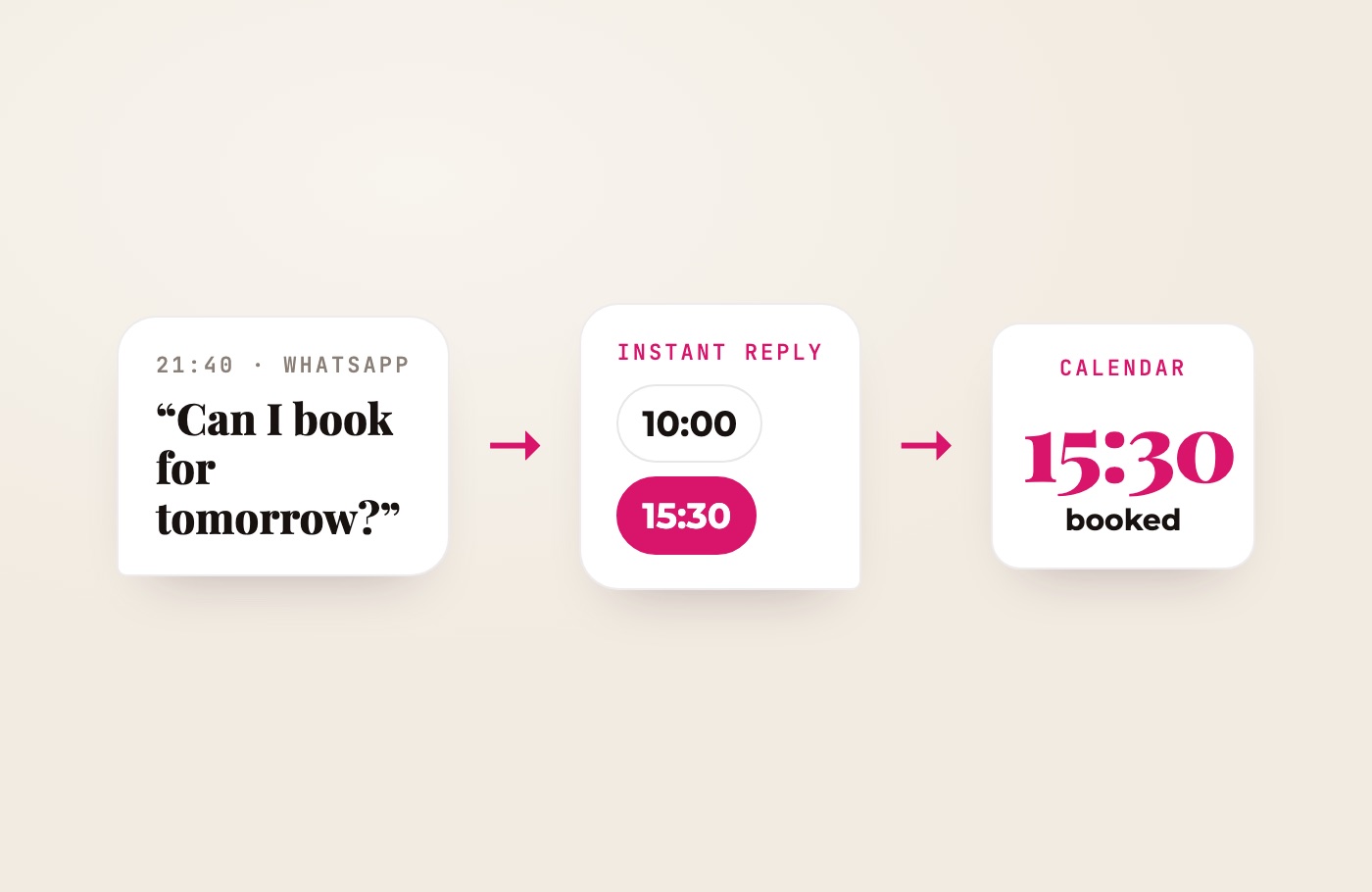
I have failed to book a manicure more than once. You call and nobody picks up. You write to the salon's inbox and the reply arrives in the evening, by which time you have booked somewhere else.
I have no complaint about the person. She is working with a client and cannot answer the phone, and that is exactly what she is paid for. Meanwhile the phone rings into an empty room and the person on the other end simply moves down the list.
Why booking usually comes first
The first automation task in a service business is not "introduce AI". It is to stop losing people during the hours when you physically cannot answer.
In a service business those hours are the working ones. The therapist is with a client, the coach is running a session, the doctor is seeing someone. That is exactly when everyone else writes, and exactly when nobody replies.
The difference between "answered in a minute" and "answered in the evening" is not about manners. It decides whether the person booked with you or with whoever answered first.
What automated booking actually consists of
When I say automated booking I mean a set of concrete steps, not an abstract bot.
- A messageoutside working hours
- An answer at oncewith two or three free slots
- The client picksone tap, no back-and-forth
- It lands in the calendarwhere you will see it
- A reminder the day beforeconfirm or move
An answer straight away
Someone writes and gets a reply now, not in six hours. Even a short "let me find you a time" holds the conversation and shows the message was seen.
Real free times offered
Not "when suits you?", but two or three specific slots from your actual calendar. Asking "when suits you" hands the work back to the client and adds another round of messages.
It lands in the calendar
The chosen time goes where you will see it, without being copied across by hand. That calendar stays the single source of truth about your availability.
A reminder and confirmation the day before
The client confirms or moves the appointment in advance instead of silently not turning up. For anyone billing by the hour, one moved appointment instead of a lost one pays for the setup.
None of these steps needs artificial intelligence. These are ready-made booking services that have to be chosen well and set up around your services, hours and breaks.
Automation in a service business is almost never about clever technology. It is about letting someone who already wants to come to you reach the booking while you are busy with another client.
Darina Solomakhina
How to tell whether this is your first task
A simple check over one week. Count two numbers: how many enquiries arrived outside working hours, and how many of those ended in a booking.
If the first number is noticeably larger than the second, start here. Few other automations pay back faster, because you are losing people who had already decided they wanted to come.
If enquiries are few and the real problem is that you are drowning in paperwork, your first task is a different one. It is below.
Three scenarios from practice
Voice notes that turn into tasks
One of my clients dictates his tasks. It suits him: he is driving or between meetings, with no time to type.
Those voice notes used to sit in a chat and half of what was said got lost. So we built this: he sends a voice note, it is transcribed, broken into separate tasks and lands in the CRM already structured — with the project it belongs to and what counts as done. I work from that list.
Here AI genuinely earns its place: transcribing speech and pulling separate items out of a free-flowing monologue is exactly the work it is good at. After that everything runs on ordinary rules: the task goes to the right project and does not disappear.
Enquiries from several places in one list
A form on the website, a message on Instagram, a phone call — right now that is three different places, and something always falls through.
All of it can land in one table or CRM: the contact, the source, what the person asked, and a notification to whoever answers. Nothing clever happens here; you no longer need to monitor three separate places. A side effect: after a month you can see which channel actually brings clients and which only feels like work.
Documents and recurring reports
A client fills in a form, a document is assembled from it using your template, you check it and send it.
The same principle works for regular summaries: the numbers are collected from the tools that already hold them rather than retyped into a spreadsheet in the evening. This is rarely the first task, but it is almost always the second — because it eats time exactly when the working day is already over.
How to choose the first task
I would judge it on three things at once:
- It repeats. The task comes back every week, not once a quarter.
- The result is checkable. The booking exists or it does not. The document is ready or it is not. No "it feels smoother".
- The timing. Today it takes your attention exactly when you are busy with the work people pay you for.
Booking usually meets all three, which is why it often makes sense as the first step.
What is fair to say in advance
The running costs
Automation is not free to keep: the services have subscriptions, and their cost should be worked out before you start, not after. What the reminders can do depends on the plan you choose — some include them, some do not.
Where the line sits
Before the setup you have to decide what the system answers itself and what it passes to you. It can answer "how much does it cost" and offer a time. Deciding whether to take on a difficult client, or to make an exception on price, it cannot — and should not.
Start with one task. The one that will certainly come round again this week.