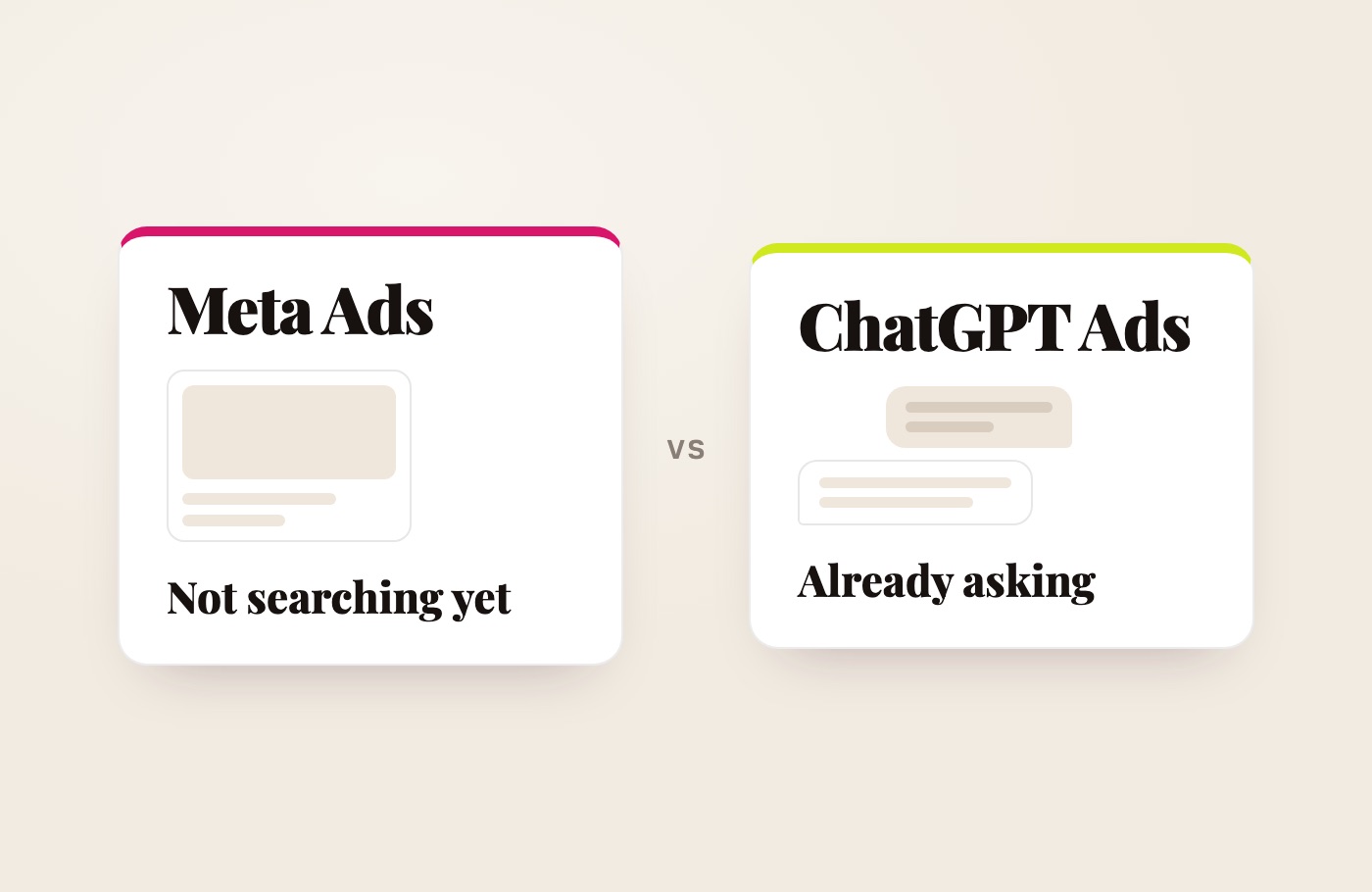
"Which is better, Meta or ads in ChatGPT?" I have been asked this so many times in recent months that it has become clear the question is put the wrong way round.
These are not two ways of doing the same thing, with the cheaper one to be picked. The two channels reach people at different moments. On Meta you show up for someone who was not looking for you yet. In ChatGPT you show up when somebody has already put their problem into words.
That difference shapes everything else: what the ad has to do, what the page has to explain, and what counts as a good result.
How each channel works
| Meta Ads | Ads in ChatGPT | |
|---|---|---|
| Who starts | You show an ad to someone who was not looking for you yet | The person asked the assistant a question |
| What delivery is based on | Interests, behaviour, lookalike audiences | The context of the conversation, plus geo-targeting and custom audiences |
| Where it appears | In the Facebook and Instagram feed and stories | Alongside the assistant's answer, separate from it |
| Formats | Photo, video, carousel, Reels | Changing quickly — checked in Ads Manager before each launch |
| Who sees it | Facebook and Instagram users in the chosen audience | Plans where ads are shown, 18+. No ads on Plus, Pro or business plans |
| Measurement | Meta Pixel and the Conversions API | OpenAI Pixel and the Conversions API |
| Data volume | Depends on the niche; the platform needs conversions to learn | Depends on the niche and country; still being established |
Meta Ads: you start the conversation
Someone is scrolling a feed and asked you for nothing. Delivery is built on what the platform knows about people: interests, behaviour, lookalike audiences. You interrupt whatever they were doing and have a second or two to explain why they should stop.
That is why the image matters so much, why the offer has to read without context, and why the platform needs conversions before it can find more people like the ones who responded.
Ads in ChatGPT: they start it themselves
Here it is the other way round. The person is already typing their question, with the details, the city, the constraints, and the ad appears alongside the assistant's answer, clearly separated from it.
In OpenAI's own words, delivery takes into account the context and intent of the current conversation, together with the landing page, the headline and the copy of the ad itself (OpenAI help centre). On top of that, advertisers can now narrow delivery with geo-targeting and custom audiences, and optimise towards conversions rather than only paying per impression or per click (OpenAI).
Formats and options in this channel are changing quickly, so I check what Ads Manager actually offers before planning the creative for a campaign.
Three differences that decide the choice
Who starts
On Meta the initiative is yours: you ask for attention the person was not planning to give. In ChatGPT the initiative is theirs: you appear next to a question they chose to ask.
The practical conclusion: if your service is one nobody thinks about until they see it, Meta is the natural place to start. If people look for it in words because the problem is already there, ChatGPT Ads can meet them at a later stage of the search.
Who you can reach
Ads in ChatGPT are not shown on every plan.
Ads are not shown to users on Plus, Pro, or any Business plan, or to any accounts identified as belonging to users under 18.
OpenAI help centre
In plain terms, reach is limited to the plans where ads are shown. If your audience is mostly people who pay for tools and subscriptions, that matters. If it is a broad local audience for a service, it matters less.
Meta has its own limits — who is on the platform in your area, what the auction costs in your niche — so the honest comparison is always about your audience, not about the platforms in general.
What you can measure
Both channels are measured in a similar way: a browser pixel plus server-side conversions. On Meta that is the Meta Pixel and the Conversions API; in ChatGPT it is the OpenAI Pixel and the Conversions API.
What differs is how much data you will have. Meta needs a certain number of conversions to get through its learning phase. How much volume ChatGPT Ads produces in a given niche is still being established, so conclusions there should rest on your own data rather than on anyone's averages.
Which one is for you
If nobody thinks about your service until they see it
Aesthetics, beauty, jewellery, anything chosen emotionally and by the picture: start with Meta. That is where the visual formats are and where the platform can learn from your first conversions.
If people put the task into words
An accountant, a lawyer, a tutor, repairs, a move, physiotherapy — things people look for once the need is already there. Those requests get described in detail inside an assistant, and an ad next to the answer meets that moment. The channel is worth testing.
If there is one budget and it is small
Do not split it in half. Optimise one channel first — the one closer to how your clients decide. Add the second as a test on a small share of the budget once the first is working predictably.
Splitting a small budget between two channels is a reliable way to gather enough data in neither.
What is fair to say about the new channel
Advertising in ChatGPT is young, and that shapes what to expect.
- It is available here now. Since 31 August 2026 self-serve ChatGPT Ads has been open through Ads Manager in 31 European countries, Italy included (OpenAI). Account and eligibility checks still apply before the first campaign.
- Reach depends on the plan. People on Plus, Pro and business plans do not see ads.
- The toolset is growing fast. Conversion optimisation, geo-targeting, custom audiences, the OpenAI Pixel and the Conversions API are all recent. Details change, so they are checked before each launch.
- There is little data to generalise from. The channel opened in 2026, and I would not draw conclusions from other people's case studies.
That is why I treat it as an additional test channel alongside the one that already works, not as a replacement.
How I decide in practice
Each channel gets a role first: Meta to reach people who are not searching yet, ChatGPT Ads to meet people who already are. Then both run long enough to produce data you can read.
The comparison is not only about cost per enquiry. What matters is the quality of the enquiries, how many of them turn into bookings, and the revenue behind them. A cheaper enquiry that never books is not the better result.
One thing has to work before any of that: the page the traffic goes to. If there is nowhere clear to send people, neither channel will pay for itself, and the choice between them stops mattering.