ChatGPT already recommends one of my clients. That makes AI visibility a practical business question for me.
It does not mean everyone has stopped using Google, or that one recommendation proves a particular website change worked. But customers can now ask an assistant to compare businesses and suggest someone suitable before visiting a website.
SEO remains essential. My view is that measuring visibility only through Google rankings no longer gives us the full picture.
SEO and GEO: different goals, shared foundations
SEO, or search engine optimisation, helps people find your website through search engines.
GEO, or generative engine optimisation, focuses on helping AI systems find, understand and use information about your business in their answers.
The overlap is substantial. Google explicitly says its AI search features rely on existing SEO foundations and require no special optimisation. GEO should therefore extend a sound website strategy, with attention to how different assistants access and present information. Google's guidance on AI features.
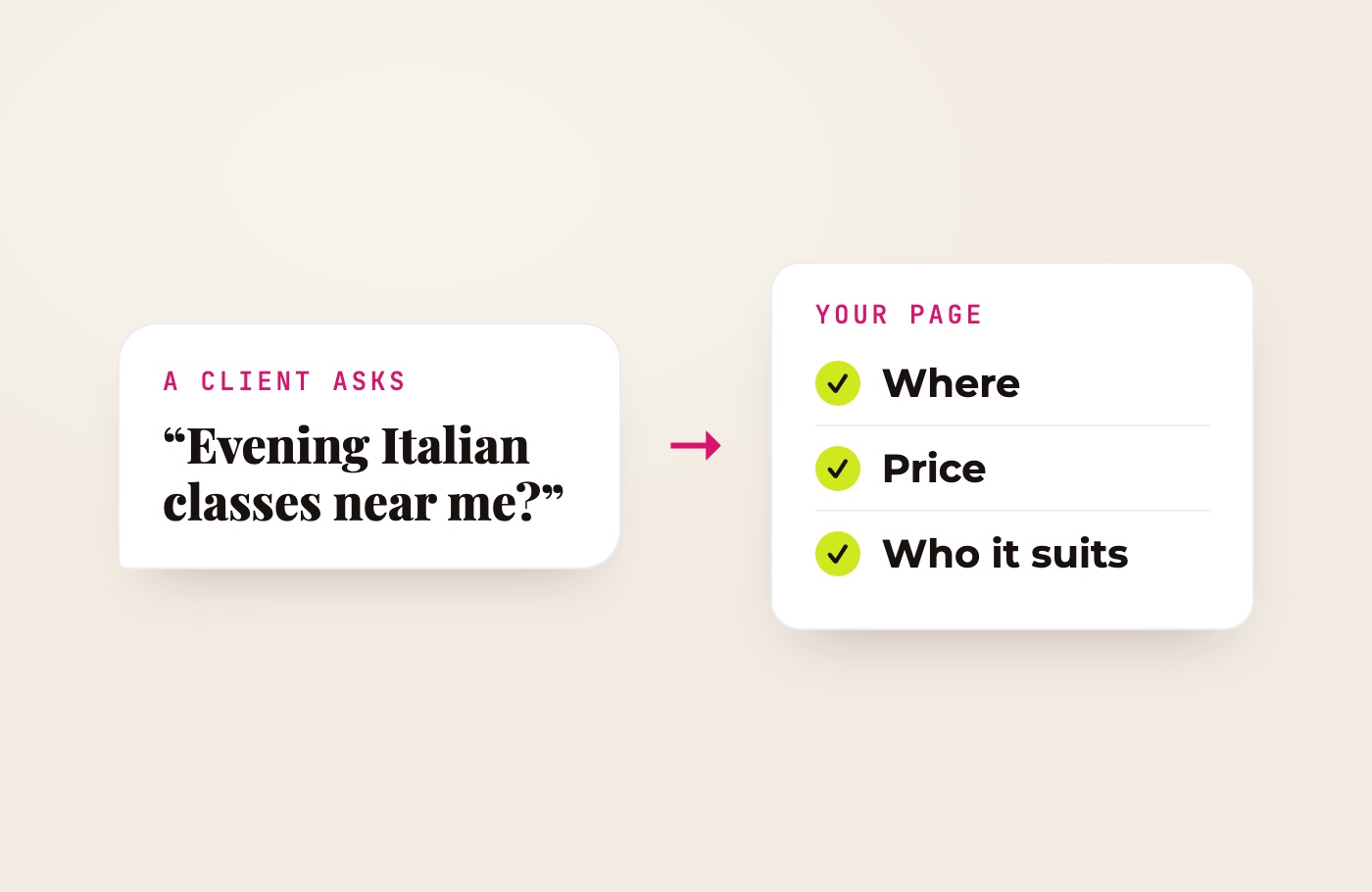
Imagine a small language school in Bolzano. A prospective student asks ChatGPT: "Where can I take evening Italian classes for beginners in a small group?"
A website saying "Discover your potential through languages" leaves most of that question unanswered.
- A question to the assistant“where can I book…”
- The crawler reaches the pageif access is not blocked
- It reads the factsplace, price, who it suits
- It checks the profilesdoes the data match
- You appear in the answerthe service decides
First, check whether your pages are accessible
Before rewriting anything, establish whether search systems can reach the school's course pages.
Set up Google Search Console and Bing Webmaster Tools, the search engines' website dashboards. Check your main pages and submit your sitemap: a file listing the pages you want search engines to discover. Submission helps discovery; it does not guarantee inclusion. Google's sitemap documentation.
For ChatGPT search, a specialist should check access for OAI-SearchBot, OpenAI's automated search crawler. Your robots.txt file, which gives crawlers access instructions, and your website's security settings can block it.
GPTBot serves a different purpose: collecting content that may be used for model training. You can allow the search crawler while blocking the training crawler. Giving training permission is not a prerequisite for search visibility. OpenAI's crawler documentation.
Google's AI features in Search build on existing SEO practices and need no special optimisation.
Google Search Central documentation
Give the assistant enough information to assess a match
For our hypothetical school, I would prioritise a clearly labelled beginner course page stating the location, lesson language, timetable, group size, price and enrolment process.
Those details should appear as readable page text. Essential information should not exist only inside a promotional image. Google specifically recommends making important content available in textual form. Google's guidance.
Then answer the questions that determine whether someone can actually attend. Is previous knowledge required? Can students join mid-term? What happens if they miss a lesson?
My reasoning is straightforward: specific answers provide material that can support a relevant recommendation. Repeating "best Italian school" provides an opinion without explaining suitability.
Make claims easy to verify
I would also check the teachers' biographies, qualifications and consistency between the website and public business profiles. If the school advertises groups of six, its course page should explain that clearly.
This is my credibility check, rather than a claim about a guaranteed ChatGPT ranking factor.
Structured data can help search engines interpret factual details. It is code that labels information such as an organisation's name and address. It should describe what visitors can actually see, and it does not guarantee an AI recommendation. Google's structured data introduction.
What you can handle, and where specialist work begins
The owner can correct outdated details, publish clear course descriptions and collect the questions people ask before booking. That knowledge is often already sitting in emails.
The work I would take on is diagnosing access and indexing problems, checking what crawlers receive, validating structured data and deciding which pages need restructuring first.
I would separate technical obstacles from missing information. Publishing more articles will not resolve a blocked course page; correcting access will not explain who the course suits.
A ten-minute check to start with
Choose one service page and write down a specific request your ideal customer might give ChatGPT.
Using only that page, underline the facts that demonstrate a match. Circle anything missing: location, suitability, price, availability or evidence of expertise.
Add the most useful missing answer first. You will have made your business easier to assess, whoever is doing the searching.