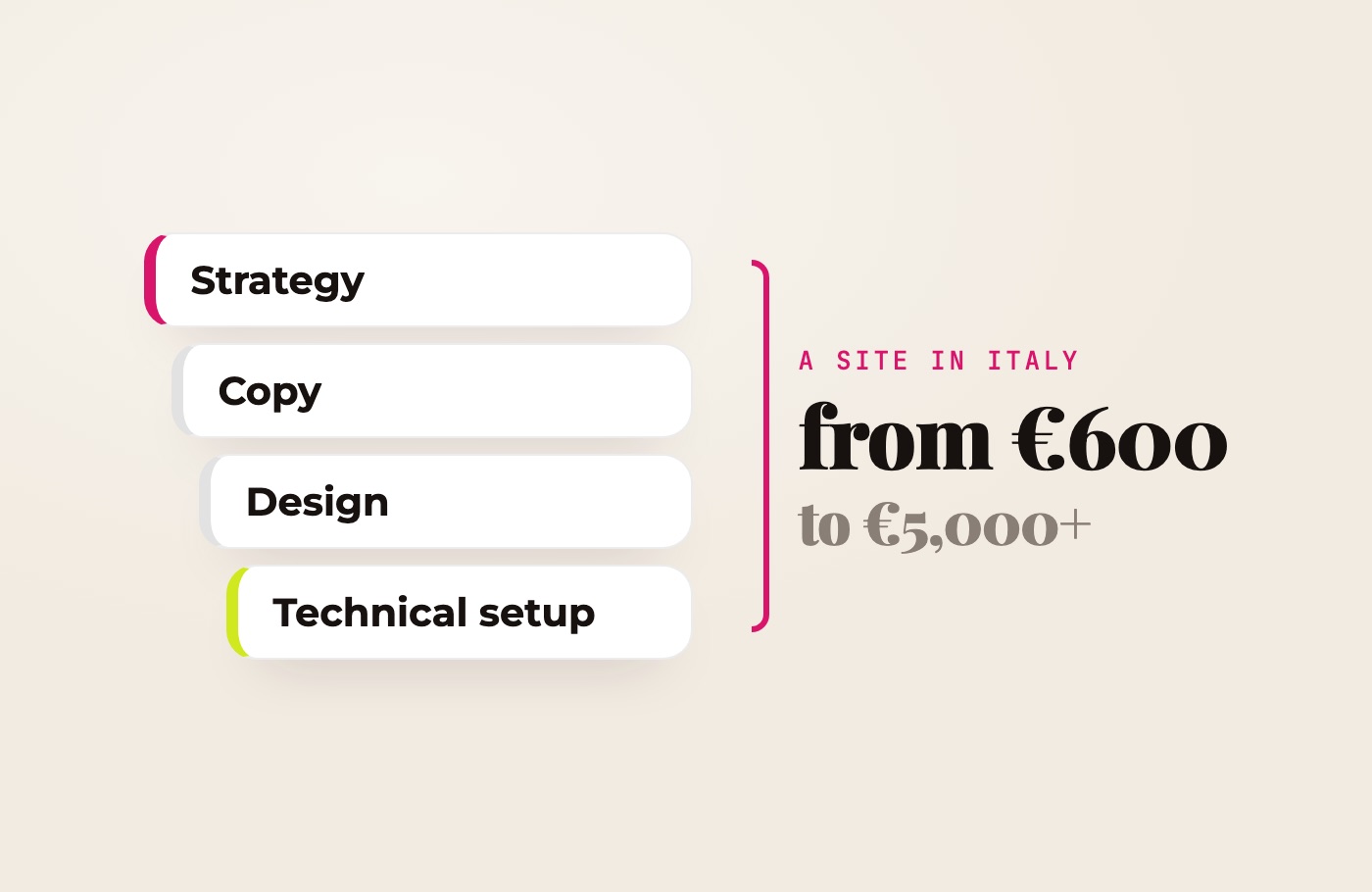
The short answer: a focused one-page website for a professional or a single service may start at around €600. A multi-page or multilingual site—or one that includes booking, payments or custom integrations—will usually require a budget in the thousands.
But comparing websites by page count alone is a little like comparing restaurants by the number of tables. The figure tells you very little about the thinking behind the offer, the customer journey, the copy or the technical setup.
Here is what actually determines the cost of a business website in Italy, which expenses are essential, and what to clarify before a project begins.
Why website quotes vary so widely
There is no standard market rate for “a website”. The same request can describe very different projects:
- a simple online presence with contact details;
- a landing page for one service or advertising campaign;
- a company website covering several services;
- a multilingual site serving different markets;
- a catalogue, online shop or platform with user accounts;
- a redesign that needs to preserve valuable content and existing search visibility.
The scope behind each quote also varies. One provider may install a ready-made template. Another may research the audience, shape the site structure, write the copy, create a bespoke design, configure analytics and prepare each page for search.
So the useful question is not “How much does a website cost?” It is “What kind of website does my business need, and what is included in the quote?”
Typical website cost ranges in Italy
The figures below are practical reference points, not an official price list or a statistical average. Actual quotes depend on the provider, platform, scope and level of complexity.
| Format | Indicative budget | Best suited to |
|---|---|---|
| DIY website builder | roughly €100–600 per year, excluding your time | A basic online presence, temporary page or early test |
| One-page site by an independent specialist | roughly €600–1,500 | A single service, independent practice, event or campaign |
| Small multi-page website | roughly €1,500–5,000 | Several services, case studies, articles and room to grow through search |
| Bespoke studio or agency project | from €3,000 upwards | Research, a larger team, complex structure or non-standard features |
| Ecommerce site or web platform | quoted separately | Payments, catalogues, user accounts and custom workflows |
Public directories of Italian web agencies often show higher starting prices for small corporate websites. That reflects more than development quality: agency overheads, project management and a larger delivery team all affect the quote. An independent specialist can often work at a lower cost when the scope is clear and the project does not require complex development.
The sensible comparison is not between two totals. It is between two scopes of work.
What a professional website quote should include
1. Business goal and site structure
Before design begins, someone needs to establish:
- who the website is for;
- which service or offer it needs to explain;
- what a visitor should understand on the first page;
- which doubts may stop them from enquiring;
- what the next step should be: a call, a message, a booking or a purchase.
Without this work, a polished website can still be little more than an online brochure. Visitors may see attractive images and broad claims without understanding whether the offer is relevant to them.
2. Website copy
“Copy included” can mean several things. A provider may simply upload text supplied by the client, lightly edit it, or conduct an interview, gather evidence and write every page from scratch.
Before accepting a proposal, clarify:
- who supplies the source material;
- how many pages or sections will be written;
- whether editing and revisions are included;
- whether translation is included;
- who checks that each language sounds natural.
For a multilingual website, replacing words with their equivalents in another language is not enough. The offer, terminology and calls to action need to feel natural to each audience.
3. Design and mobile experience
A ready-made template reduces time and cost. A more bespoke design takes longer, but it can express the character of the business more precisely and create a clearer visual hierarchy.
The point is not decoration for its own sake. Design should help a visitor:
- understand the offer quickly;
- notice what matters;
- read without effort;
- find evidence and answers;
- contact the business easily from a phone.
Mobile design is not an optional extra. Many local-business visits happen on a smartphone, so forms, buttons, menus and booking flows need to work properly on a smaller screen.
4. Development and technical setup
This is where the approved design becomes a working website. Depending on the project, the quote may include:
- responsive development;
- domain connection;
- a contact form;
- spam protection;
- basic analytics;
- sitemap and robots.txt configuration;
- testing links and layouts across devices;
- launch on the client’s domain;
- handover of files and access.
A page can look finished while its forms fail, its key actions are not measured, or search crawlers cannot access its content. Visual completion and technical completion are not the same thing.
5. Preparation for Google and AI systems
Basic search preparation normally includes a clear page structure, meaningful headings, page titles and descriptions, internal links, a sitemap and a check that the pages can be indexed.
Google describes SEO as work that helps a search engine understand a page and helps people decide whether to visit it. That distinction matters: SEO is not a promise of a first-page ranking. It creates the conditions for a page to be found, interpreted and matched to a relevant search.
Preparation for AI systems begins with much of the same foundation. A website should contain clear facts about the business, its services, location, author and experience. Crawlers need technical access; AI systems need enough specific information to understand when the business may be relevant.
No designer, consultant or agency can guarantee a particular Google position or a mention in a ChatGPT answer. We can improve access, structure and content quality, but the final decision belongs to the search engine or AI service.
6. Additional functionality
Costs increase when a project requires functions that need separate configuration or development, such as:
- online booking;
- payments;
- a product or service catalogue;
- customer accounts;
- a CRM;
- WhatsApp or email integrations;
- an AI assistant;
- a bespoke calculator;
- automated data transfer between tools.
Not every feature needs to be built from scratch. For many small businesses, choosing a reliable existing service and integrating it properly is the more sensible option. It costs less to launch, is easier to maintain and leaves the owner with a system they can understand.
Costs that are often charged separately
Once the website has been built, there may be recurring costs for:
- the domain;
- hosting or a platform subscription;
- business email;
- paid fonts, images or licences;
- booking software;
- SMS or WhatsApp messages;
- analytics and marketing tools;
- technical support;
- new content;
- ongoing SEO work.
A domain is normally renewed annually through a registrar. Hosting and website platforms may be billed monthly or annually. As these prices can change, a clear proposal should separate the website project fee from subscriptions paid directly to third-party services.
Ownership matters too. The domain, website, analytics and essential service accounts should either be registered in the client’s name or transferred under terms agreed before work begins.
How can a professional website start at €590?
A lower starting price does not automatically mean lower quality. It may simply mean that the scope is tightly defined.
At Alpine Web Studio, a one-page website starts at €590. The base format includes one agreed page, structure and copy developed from the client’s information, responsive design, a contact form or connection to an existing widget, and basic SEO and GEO preparation.
That price is possible when:
- the project has one clear service or offer;
- no complex bespoke functionality is required;
- the client provides the necessary facts and materials;
- the number of sections and revision rounds is agreed in advance;
- additional languages and paid services are quoted separately.
A business with several services, extensive content, complex integrations or multiple languages needs a different scope. Pretending that every website can be delivered properly for the same fixed fee would not be honest.
Three example budgets
An independent professional with one core service
Goal: Explain the approach, establish credibility and lead visitors to a booking.
Suitable format: A one-page website covering the service, the practitioner, reviews, common questions and a clear booking route.
Indicative range: €590–1,500, depending on the copy, design, language and booking setup.
A local business with several services
Goal: Explain different areas of work and generate enquiries through search and advertising.
Suitable format: A multi-page website with individual service pages, case studies, contact information and an insights section.
Indicative range: Approximately €1,500–5,000, depending on page count, copy, functionality and content preparation.
A business working in more than one language
Goal: Speak to different audiences while keeping one coherent position.
Suitable format: A separate URL for each language version, adapted copy and metadata, and correct connections between equivalent pages.
Google recommends separate URLs and hreflang annotations for multilingual versions. Technical setup is only part of the work, however. A literal translation can be grammatically correct and still fail to persuade or even sound credible.
The budget is calculated once the number of pages and languages is known. It does not always multiply exactly by the number of languages, but translation, adaptation and proofreading require additional time.
How to compare website proposals
Before choosing a provider, ask for the following points in writing:
- Number of pages and languages.
- Who is responsible for the structure and copy.
- Whether the design is template-based or bespoke.
- How many design concepts and revision rounds are included.
- Which forms and integrations will be connected.
- What “SEO and GEO preparation” actually includes.
- Who pays for the domain, hosting and third-party services.
- Who owns the accounts and access credentials.
- What happens after launch.
- Which requests will be treated as additional work.
A good proposal does not have to be long. It does need to make the result, the client’s responsibilities and any potential extra costs clear.
Which type of website does your business need?
A one-page site is often enough when you have one main service, a simple enquiry route and no immediate need to target a wide range of search queries.
A multi-page website is usually the better choice when:
- different services speak to different audiences;
- each area needs a proper explanation;
- you plan to publish useful content regularly;
- organic search is expected to become a distinct acquisition channel;
- the business has several case studies, specialists or locations.
If a website already exists, a complete rebuild may not be necessary. Improving the first screen, navigation, copy and a handful of key pages may be enough. That decision should follow an audit—not a passing dislike of the old design.
Conclusion
A small-business website in Italy may start at around €600 and rise as the number of pages, languages, research requirements and functions increases. Neither the lowest nor the highest quote is automatically the right one for your business.
Compare the scope, the future running costs, and how well the proposed website will help a potential client understand the offer and take the next step.
If you are unsure whether you need a landing page, a multi-page website or a redesign, the process can begin with a short discussion. Before work starts, I will recommend a suitable format, list any additional costs and define the scope in writing.